Lentigines
-
90%
solar lentigines in fair-skinned individuals 60+
-
Permanent markers
lentigines do not fluctuate with the seasons
-
30 and under
clinical data shows an increasing prevalence of lentigines
-
80%
are located on the face, the back of the hands, and the upper trunk
UNDERSTANDING Lentigines
Precision Pigment Care: Beyond the Surface of “Age Spots”
For many residents in Birmingham and Hoover, the appearance of small, darkened spots on the hands, face, and shoulders is often dismissed as an inevitable sign of aging. Clinically known as Lentigines, these spots are more than just “freckles”—they are localized proliferations of melanocytes resulting from cumulative environmental exposure. At Inverness Dermatology, we move beyond over-the-counter “brightening” creams to provide a clinical path to diagnosis and pigment clearance that prioritizes both aesthetic results and the long-term health of your skin.
The Anatomy of a Lentigo
Unlike common freckles (ephelides), which darken with sun exposure and fade in the winter, a Lentigo is a permanent structural change in the skin. This condition is a disorder of Melanocytic Proliferation, where the actual number of pigment-producing cells increases at the dermal-epidermal junction. This leads to a stable, well-defined area of hyperpigmentation that does not fluctuate with the seasons. Whether they are Solar Lentigines (induced by UV) or Lentigo Simplex (unrelated to sun), these lesions require targeted medical intervention to be successfully reversed.
Targeted Pigment Protocols at Inverness Dermatology
We categorize Lentigines (ICD-10: L81.4) by their distribution and cellular characteristics to ensure the most effective medical intervention.
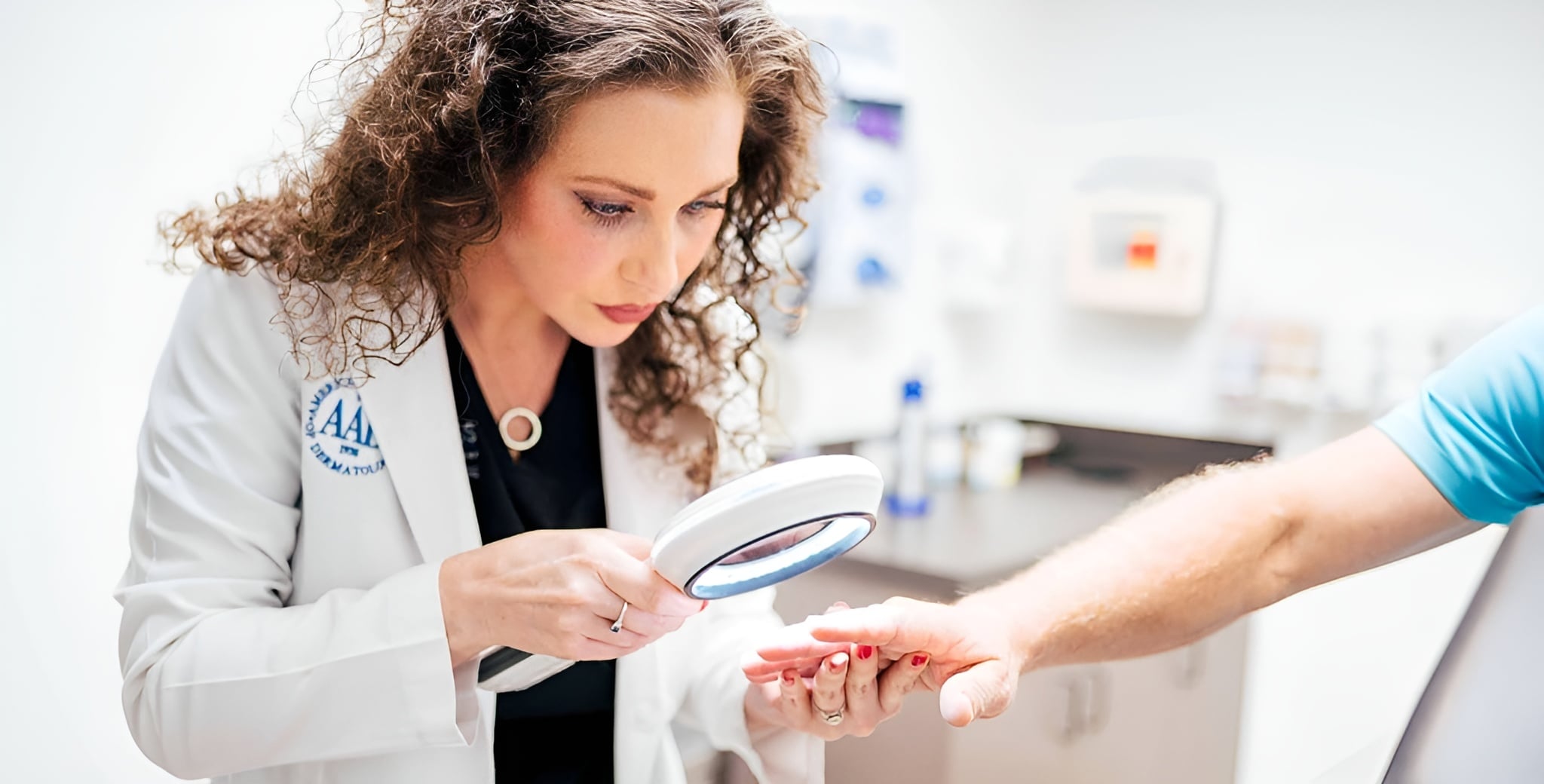
Our team focuses on Selective Photothermolysis. Because the pigment in a lentigo is concentrated, we can utilize specific wavelengths of light to fragment the excess melanin without damaging the surrounding healthy tissue. A critical pillar of our trust promise is Diagnostic Screening. Before any cosmetic treatment, our board-certified dermatologists rigorously screen every lesion to ensure it is a benign lentigo and not a more serious precursor, such as lentigo maligna.
CLINICAL DETAILS
A Breakdown of Lentigines
-
Solar Lentigo
Well-defined, tan-to-dark brown macules. These are the classic "age spots" found on sun-exposed areas like the face, dorsal hands, and shoulders. Characterized by "dirty" rete ridges (elongations of the epidermis) that are packed with melanin. They do not fade in the winter.
-
Lentigo Simplex
Usually appears in childhood or adolescence as a single, isolated, dark brown or black spot. They can appear anywhere on the body, including the palms, soles, and mucosal surfaces. Unlike solar lentigines, these do not show the same "club-shaped" rete ridge elongation and are typically smaller (under 5mm).
-
Labial & Mucosal Melanotic Macule
A flat, dark brown-to-black spot found on the lower lip (labial) or the genital mucosa. While benign, these require careful monitoring by a board-certified dermatologist to distinguish them from mucosal melanoma.
-
Ink-Spot Lentigo
Highly irregular, dark brown macules that appear in areas treated with light therapy. These often exhibit more cellular atypia (unusual cell shapes) than standard solar lentigines and require long-term surveillance.
-
PUVA Lentigo
A flat, common mole that typically appears darker and more uniform than a lentigo.
-
Radiation Lentigo
Occurs exactly within the previous radiation field. These spots are often associated with other signs of chronic radiation dermatitis, such as thinning skin or visible vessels (telangiectasia).
EVIDENCE-BASED CARE
Our Treatment Approach
Board-certified dermatologists are specially trained to diagnose and provide customized treatments.
The Science of Skin Renewal (How Treatment Works)
- Our approach focuses on Pigment Fragmentation and Epidermal Renewal. We incorporate Advanced Energy Devices (such as Q-switched or Fractional CO2 lasers) to target the melanin clusters. This energy shatters the pigment into microscopic particles that are naturally processed by the body’s lymphatic system.
- For widespread photo-damage, we may utilize Medical-Grade Chemical Peels or Cryotherapy to accelerate cellular turnover, lifting the pigmented cells and revealing a more uniform, rejuvenated skin tone.
Lentigines FAQ
Clinical answers from our board-certified dermatologists.
No. “Liver spot” is a non-medical term used because the color of the spots was once thought to resemble the liver. These spots are strictly cutaneous and are caused by UV radiation and aging, with no connection to internal organ function.
While a true lentigo is benign, it can look very similar to Lentigo Maligna, which is an early form of skin cancer. This is why a professional diagnosis by a board-certified dermatologist is the only safe way to confirm a spot is purely a cosmetic concern before initiating treatment.
Laser treatment removes the existing pigment clusters effectively. However, the underlying skin has been sun-damaged over time. Without strict adherence to medical-grade SPF and sun-protective measures, the same triggers can cause new lentigines to develop in the same area.
Freckles (ephelides) are caused by overactive cells, but the number of cells remains normal. In a lentigo, the actual number of melanocytes has increased. This is why freckles fade when the sun goes away, but lentigines are permanent until treated medically.