Scaling Scalp
-
50-80%
of people living with plaque psoriasis will experience a scalp flare-up
-
Scalp ringworm
most common fungal infection in children worldwide
-
70% of patients
report worsening scalp scaling conditions during winter months
-
100% of adults
have Malassezia yeast, the primary driver of seborrheic dermatitis
UNDERSTANDING Scaling Scalp
Precision Scalp Care: Beyond the Surface of “Dandruff”
Tired of the itch, the flakes, and the endless search for a solution? > We know that dealing with a scaling scalp is frustrating, uncomfortable, and can take a toll on your confidence. You shouldn’t have to just “live with it.”
The Anatomy of Scalp Scaling
Clinically, a scaling scalp can be due to a number of different things. The most common causes are seborrheic dermatitis and scalp psoriasis. Seborrheic dermatitis is due to an overgrowth of yeast on the scalp and typically occurs in sebaceous rich areas like the scalp, eyebrows and nasolabial folds. Scalp psoriasis is distinguished by well- demarcated plaques with scale. Other causes of scalp scaling include tinea capitis,
Targeted Scalp Protocols at Inverness Dermatology
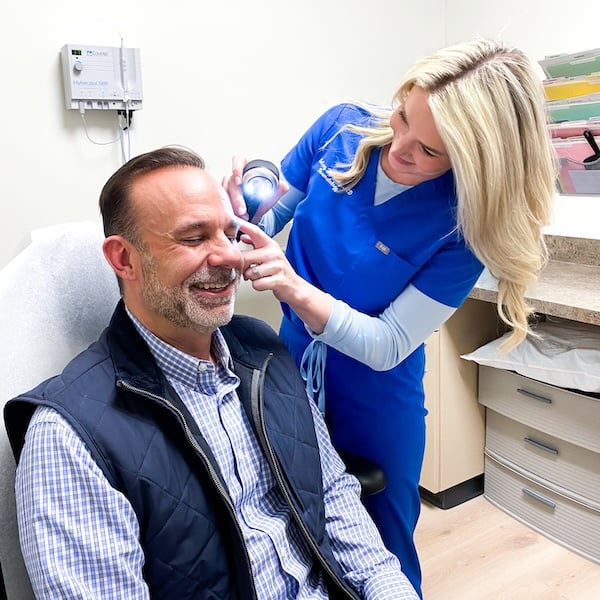
With so many underlying causes of scaling in the scalp, it’s important to see an expert. A scaling scalp can often be diagnosed based on a visual exam and clinical dermoscopy alone. However, if an infection is suspected, this can be confirmed with a fungal culture, which involves taking a swab of the affected area. If there is concern for skin cancer, a skin biopsy can be performed and sent for further microscopic evaluation by a dermatopathologist.
- For inflammatory cases, we utilize a number of topical prescription products to quiet the immune response. In more severe cases, we also have biologic medications.
- For fungal etiologies, we prescribe Systemic or Topical Antifungals to eliminate the source of infection.
- For actinic damage, we offer light treatment and topical prescription products. If the damage has progressed to a skin cancer, Mohs surgery can be performed in office.
This structured approach neutralizes the scaling cycle, restoring a calm, flake-free scalp environment.
CLINICAL DETAILS
A Breakdown of Scaling Scalp
-
Seborrheic Dermatitis
Standard "dandruff" characterized by oily, yellow scales and mild redness.
-
Scalp Psoriasis
Thick, silvery plaques that often feel "powdery" and can bleed if picked (Auspitz sign).
-
Tinea Capitis
A true fungal infection that often causes circular patches of scale and "black dot" hair breakage.
-
Sebopsoriasis
An overlap condition where a patient exhibits clinical features of both seborrheic dermatitis and psoriasis.
-
Pityriasis Amiantacea
An extreme scaling condition where thick, silver-grey scales bind the hair shafts together in "tunnels."
EVIDENCE-BASED CARE
Our Treatment Approach
Board-certified dermatologists are specially trained to diagnose and provide customized treatments.
When to see a dermatologist
- Over-the-counter (OTC) treatments are failing: If you have been consistently using OTC dandruff shampoos (containing zinc pyrithione, salicylic acid, ketoconazole, or selenium sulfide) for 2 to 4 weeks with little to no improvement.
-
The scaling is thick or crusty: Everyday dandruff usually presents as small, white flakes. If you are experiencing thick, silvery scales, yellowish greasy crusts, or heavy buildup, it could indicate psoriasis or seborrheic dermatitis.
-
You are experiencing hair loss: Scaling accompanied by hair thinning, excessive shedding, or noticeable bald patches requires immediate medical attention to prevent permanent follicle damage.
-
The itching is severe or disruptive: If the itch is keeping you awake at night, interfering with your daily focus, or causing you to scratch until you bleed.
-
There are signs of infection: Scratching can break the skin and invite bacteria. See a doctor if your scalp is oozing, bleeding, warm to the touch, has pus-filled bumps, or if you have swollen lymph nodes in your neck.
-
The rash is spreading: If the redness, scaling, or irritation moves beyond your scalp to your forehead, eyebrows, around your nose, ears, or the back of your neck.
-
Your scalp is painful or tender: A healthy scalp should not hurt. Pain or a burning sensation is a strong indicator that you need a medical evaluation.
Scaling Scalp FAQ
Clinical answers from our board-certified dermatologists.
No. While they both cause flakes, dandruff (Seborrheic Dermatitis) is usually an overreaction to yeast and produces oily, yellowish scales. Scalp Psoriasis is an autoimmune condition that produces thick, dry, silvery-white plaques that often extend beyond the hairline.
If the scaling is caused by Tinea Capitis (fungus), it is highly contagious and can be spread via hats, combs, or pillows. However, if the scaling is caused by Psoriasis or Seborrheic Dermatitis, it is absolutely not contagious. This is why a clinical diagnosis is vital.
Temporary hair thinning (Telogen Effluvium) can occur due to the inflammation of the scalp. In fungal cases like Tinea, hair can break off at the surface. Fortunately, with proper medical treatment to clear the scalp, hair usually regrows fully.
Over-the-counter shampoos have a very low concentration of active ingredients. Clinical-grade treatments are “higher-potency” and often require a prescription to reach the deeper layers of the scalp where the inflammation actually begins.