RF Microneedling Treatment
in Birmingham, AL
UNDERSTANDING RF Microneedling
Structural Rejuvenation:
Tighten and Tone without Surgery
As we age, the sharp contours of our youth—the defined jawline and firm cheeks—can begin to soften. For patients in Birmingham and Hoover looking for significant skin tightening without the downtime of a surgical facelift, RF Microneedling represents the “gold standard” in non-surgical lifting.
Targeting the Dermal-Epidermal Junction
Skin laxity is primarily caused by the degradation of Type I Collagen and Elastin in the deep dermis. Traditional topical treatments cannot reach these depths. To see a real “lift,” we must deliver energy to the structural “scaffolding” of the skin. By combining physical microneedling with deep-reaching Radiofrequency heat, we can target the exact layers where “snapping” and “lifting” occur.
Customized Energy Delivery
At Inverness Dermatology, we utilize RF Microneedling to address both aesthetic and structural concerns (ICD-10: L90.5 for scarring). Our providers precisely control the depth of the needles and the intensity of the RF energy based on the thickness of your skin in different facial zones.
How Treatment Works
The process is known as Fractionated Radiofrequency Coagulation. The needles create “micro-channels” of injury, while the RF energy creates zones of Thermal Coagulation in the dermis. This dual-action triggers a massive “healing cascade,” stimulating Neocollagenesis (new collagen) and Elastogenesis (new elastin). Over the following weeks, the skin tightens, pores shrink, and the dermal layer becomes thicker and more resilient.
TREATMENT AREAS
What we treat with RF Microneedling
-
Face
The most popular area. Targets acne scars, deep wrinkles, fine lines, enlarged pores, and mild jowling by tightening the skin and stimulating collagen production.
-
Neck
Specifically addresses loose, sagging skin (sometimes called "turkey neck") and horizontal neck lines to create a tighter, more contoured profile.
-
Chest (Décolletage)
Smooths out "crepey" skin texture, deep vertical sleep wrinkles, and improves overall skin firmness and tone often lost to sun damage.
-
Abdomen
Highly effective for tightening loose or stretched skin post-pregnancy or after weight loss, as well as fading the appearance of stretch marks.
-
Upper Arms
Helps to tighten and firm the mild sagging skin often referred to as "bat wings," while improving overall skin texture.
-
Knees
Specifically targets and tightens the wrinkly or sagging skin that tends to pool just above the kneecaps as we age.
-
Thighs and Buttocks
Used to firm skin, improve overall texture, fade stretch marks, and reduce the dimpled appearance of cellulite.
PHYSICIAN-LED AESTHETICS
A Natural Approach
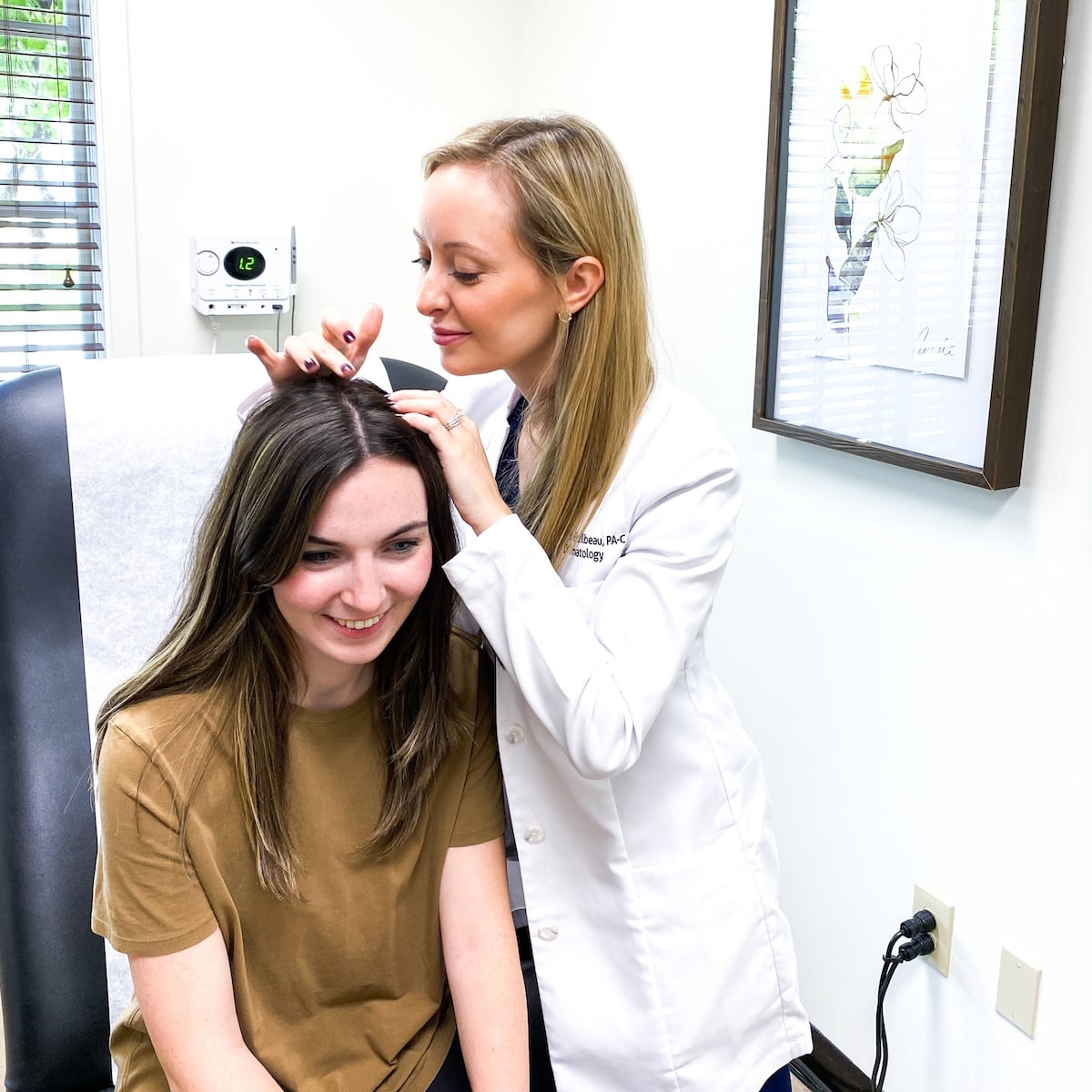
Board-certified dermatologists are specially trained to diagnose and provide customized treatments.
The Physician-Led Advantage
- Accurate assessment of chin fullness vs. skin laxity
- Strategic injection mapping to ensure even fat reduction
- Careful dosing and spacing between sessions
- Protection of surrounding structures and nerves
RF Microneedling FAQ
Clinical answers from our board-certified dermatologists.
Safety and depth are the primary differences. At-home rollers often use metal studs that enter the skin at an angle, which can cause “track-mark” tearing and scarring. At Inverness Dermatology we use the FDA-cleared SkinPen®, which utilizes vertical, oscillating surgical-grade needles. This creates clean, perpendicular micro-channels at precise depths (up to $2.5mm$) that an at-home device cannot safely reach. Furthermore, our clinical environment ensures a sterile procedure, eliminating the high risk of infection associated with home devices.
We prioritize your comfort. Before the procedure at our Inverness Dermatology clinic, we apply a high-potency, compounded topical numbing cream. Most patients describe the sensation as a light, vibrating pressure or a “sandpaper-like” feeling rather than sharp pain. Because the SkinPen® is a high-speed device, the treatment is very efficient, usually lasting only 20 to 30 minutes for the full face.
One of the reasons our patients love microneedling is the minimal recovery. Immediately after the session, your skin will look and feel like a moderate sunburn. This localized erythema (redness) and slight swelling typically subside within 24 to 48 hours. By day three, most patients can return to their normal makeup routine, revealing a “glow” as the initial healing phase completes.
While you will notice a brighter complexion after just one session, structural changes like scar remodeling or wrinkle reduction require a series of treatments. We typically recommend a “Primary Series” of 3 to 6 sessions, spaced approximately 4 weeks apart. This timeline allows your skin to complete the full collagen remodeling cycle, which takes about 28 to 30 days.
Yes. Microneedling is one of the most effective treatments for atrophic (pitted) acne scars. By breaking up the fibrous “tethers” of the scar tissue and stimulating new collagen growth beneath the indentation, the skin naturally “plumps” and levels out.
Because microneedling does not use heat or light-based energy (like lasers), it is uniquely safe for all Fitzpatrick skin types, including darker skin tones that may be at risk for hyperpigmentation with other treatments. It is an excellent option for anyone in Birmingham or Dover looking to address:
-
Fine lines and wrinkles
-
Enlarged pores
-
Acne or surgical scars
-
Overall skin texture and laxity